Beyond the Syntax: 5 Essential Books (and One Course) for the Mature Software Engineer
We’ve all been there: you can spin up a microservice in an afternoon, your PRs are clean, and you know your chosen language inside out. But suddenly, the challenges change. It’s no longer about making the code work; it’s about making it survive. How do you build a system that won’t collapse under its own weight in three years? How do you manage the "people" side of a codebase that spans a decade?
If you’ve reached the point where you’re thinking more about systems than functions, you’ve graduated from "programming" to "software engineering." The following resources are not for beginners. They don’t contain "Hello World" tutorials. Instead, they offer a masterclass in the concepts and approaches that remain true regardless of whether you’re writing Rust, Go, Python, C#, or Java.
1. Programming is a Craft, Not a Factory Line
The Source: Code Complete by Steve McConnell
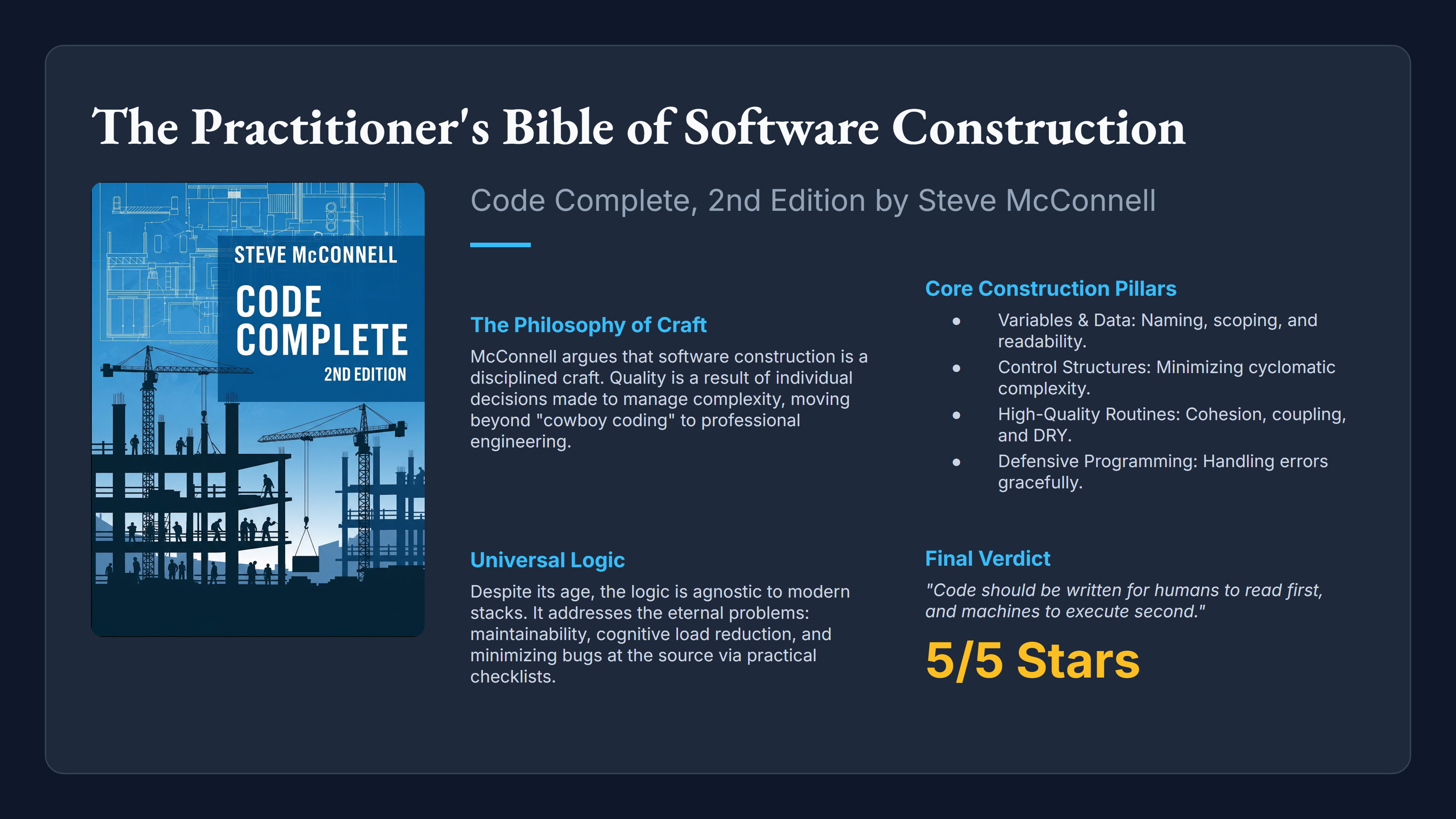
While the code examples might feel vintage (C++ and Visual Basic), the wisdom in Code Complete is timeless. McConnell argues that "construction" is the most critical phase of development. For the mature engineer, this book serves as a reminder that the quality of a system is the sum of a thousand small, disciplined decisions.
"The most important task in software development is managing complexity. Code should be written for humans to read first, and machines to execute second."
Why it matters: In an era of AI-generated snippets, McConnell’s focus on the psychological impact of variable naming and routine length is a necessary anchor. It challenges you to treat your code as a document for your future self.
2. Let Your Architecture "Scream" Its Purpose
The Source: Clean Architecture by Robert C. Martin
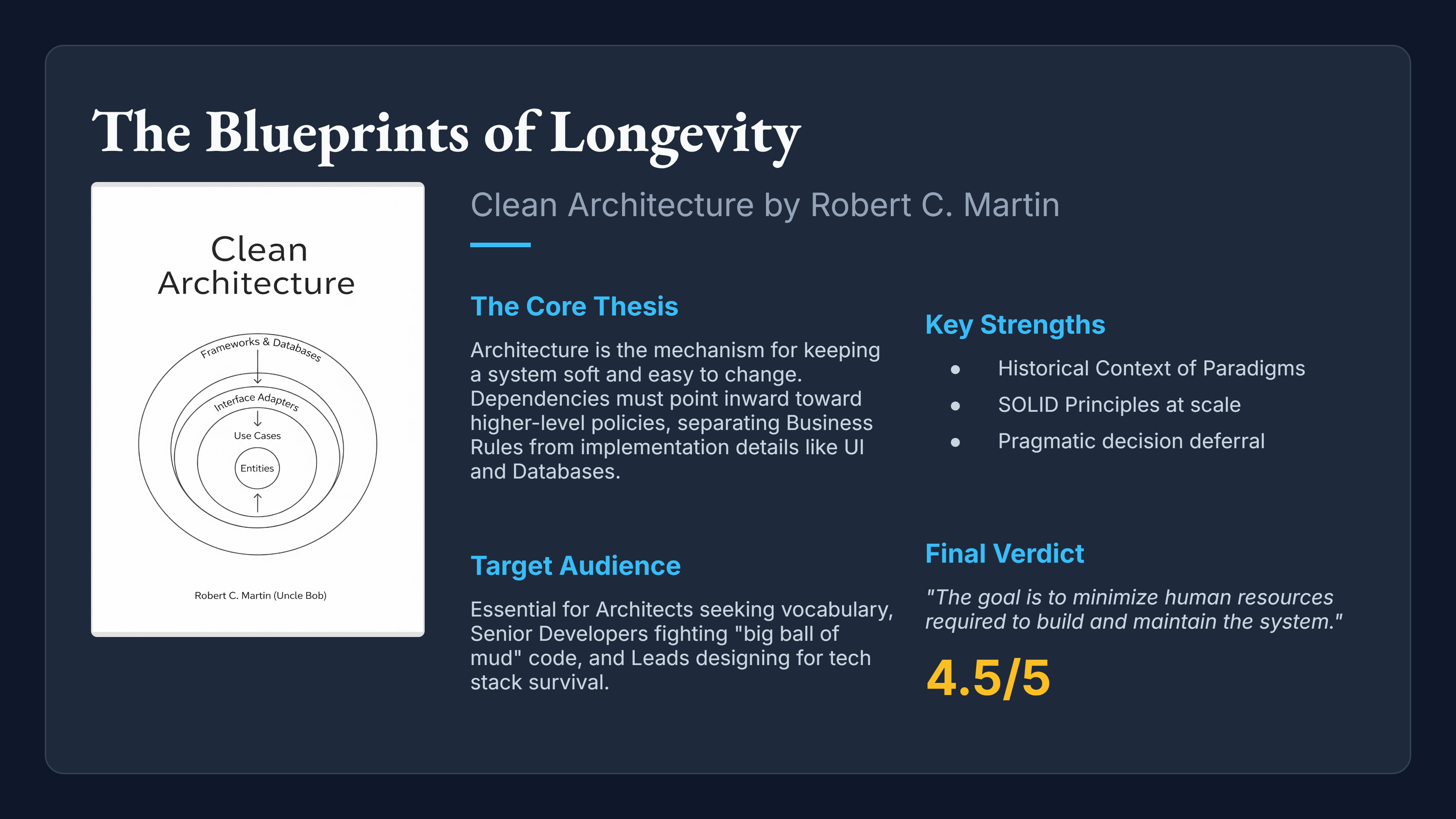
For the mid-career developer, this book is a revelation; for the veteran, it’s a brilliant systematization of hard-won lessons. One of the most impactful takeaways is the concept of Screaming Architecture. Martin argues that your folder structure should tell you what the system does (e.g., "Order Processing"), not what frameworks it uses (e.g., "Controllers," "Models").
Why it matters: Martin’s "Dependency Rule" states that dependencies must only point inward toward business logic, which serves as the ultimate defense against framework fatigue. He makes the bold, liberating case that your database and UI are merely "details" that should be deferred as long as possible.
3. Unbundling the Database
The Source: Designing Data-Intensive Applications by Martin Kleppmann
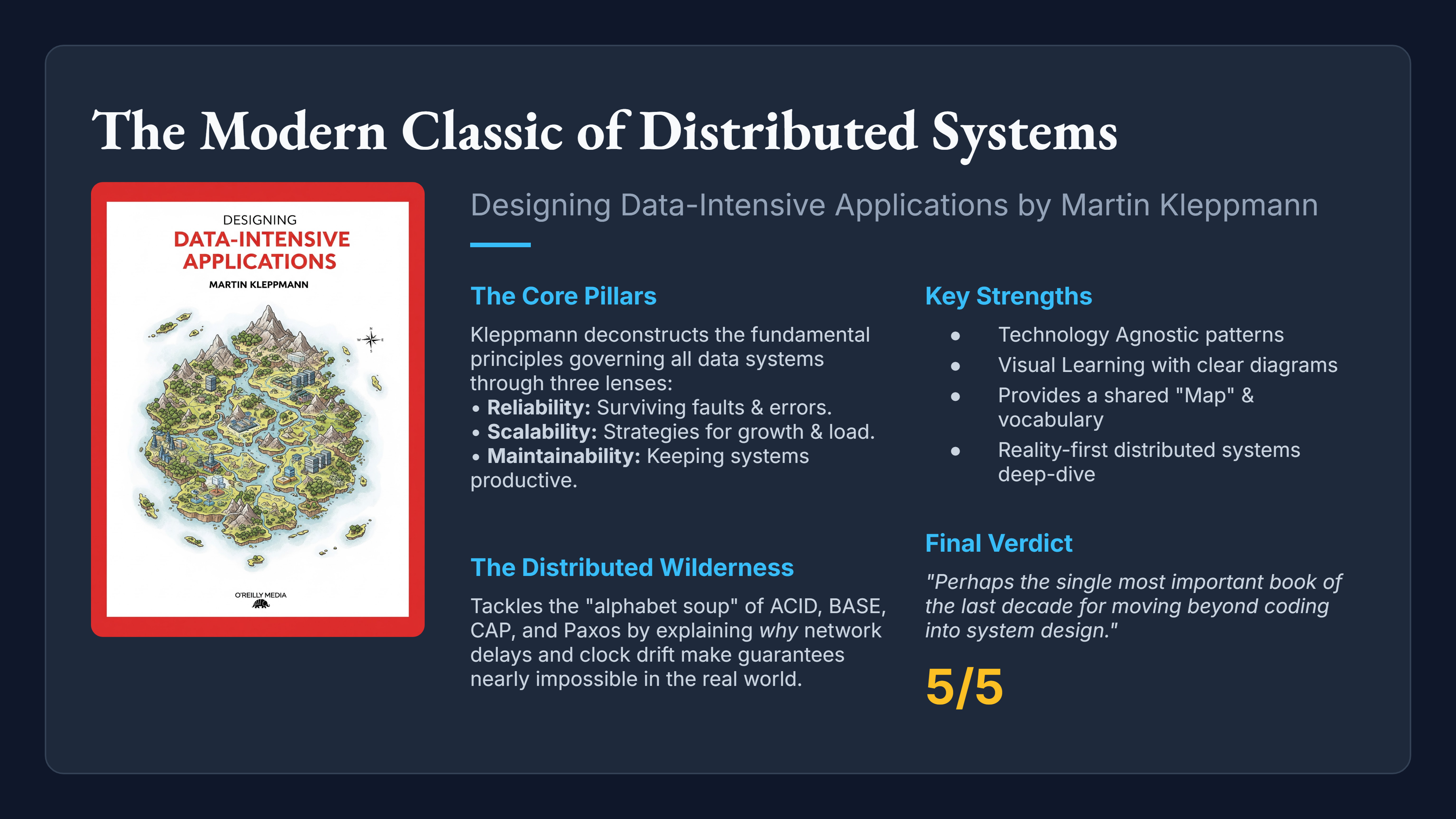
Often called "the big animal book," this is arguably the most important text for modern system design. Kleppmann’s most "brain-bending" idea is that we should view our entire application architecture as one giant, distributed database, where tools like Kafka or Elasticsearch are just different "views" or "indexes" of the same underlying data.
Why it matters: It provides the vocabulary to stop saying "we need a fast database" and start saying "we need a leaderless replication model to handle cross-region writes." It turns "magic" distributed systems into understandable trade-offs between consistency and availability.
4. Engineering is Programming Integrated Over Time
The Source: Software Engineering at Google by Titus Winters et al.
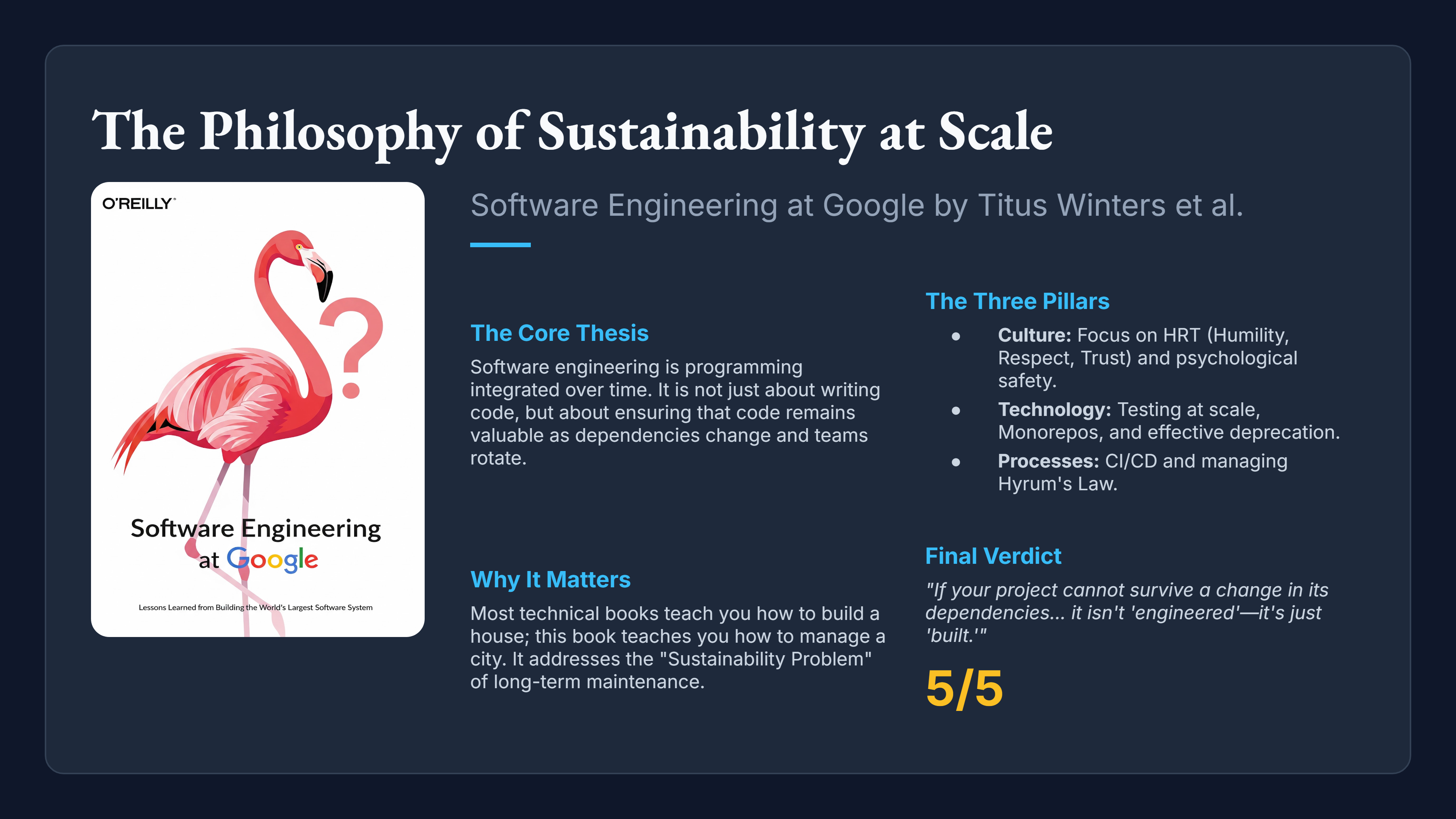
This book provides a startlingly clear definition: Programming is the act of producing code; Engineering is the act of maintaining that code for years or decades. It introduces "Hyrum’s Law," which warns that with enough users, every observable behavior of your system will be depended upon regardless of what you wrote in the documentation.
"If your project cannot survive a change in its underlying dependencies or the departure of its lead dev, it isn't 'engineered'—it's just 'built.'"
Why it matters: Most books teach you how to build a house; this one teaches you how to manage a city. It’s essential for anyone moving into leadership or architectural roles where "sustainability" is the primary metric of success.
5. Moving Beyond the "Vibe Check" in AI
The Source: AI Engineering by Chip Huyen
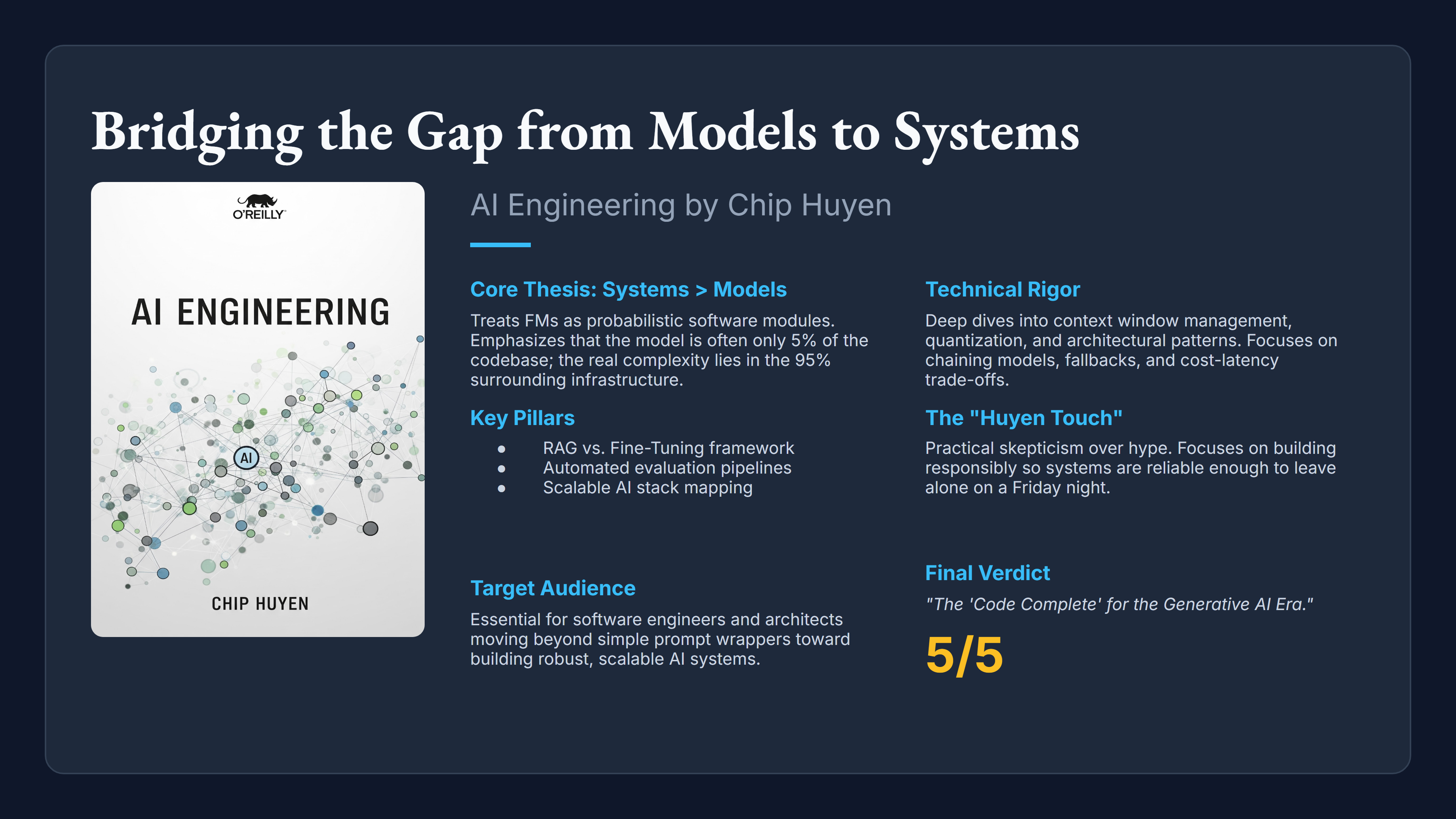
As foundation models become standard components, Huyen’s book is the first to treat AI with the same engineering rigor as a database. She moves past the hype of "prompt engineering" to focus on the 95% of the codebase that surrounds the model: evaluation pipelines, RAG vs. fine-tuning frameworks, and cost-latency trade-offs.
Why it matters: This is the "Code Complete" for the GenAI era. Huyen’s skepticism is refreshing; she emphasizes building systems that are reliable enough that you’re comfortable leaving them alone on a Friday night.
Bonus: The Gold Standard of Mental Models
The Resource: Algorithms Part I(Coursera) and Algorithms Part II (Coursera) by Princeton University
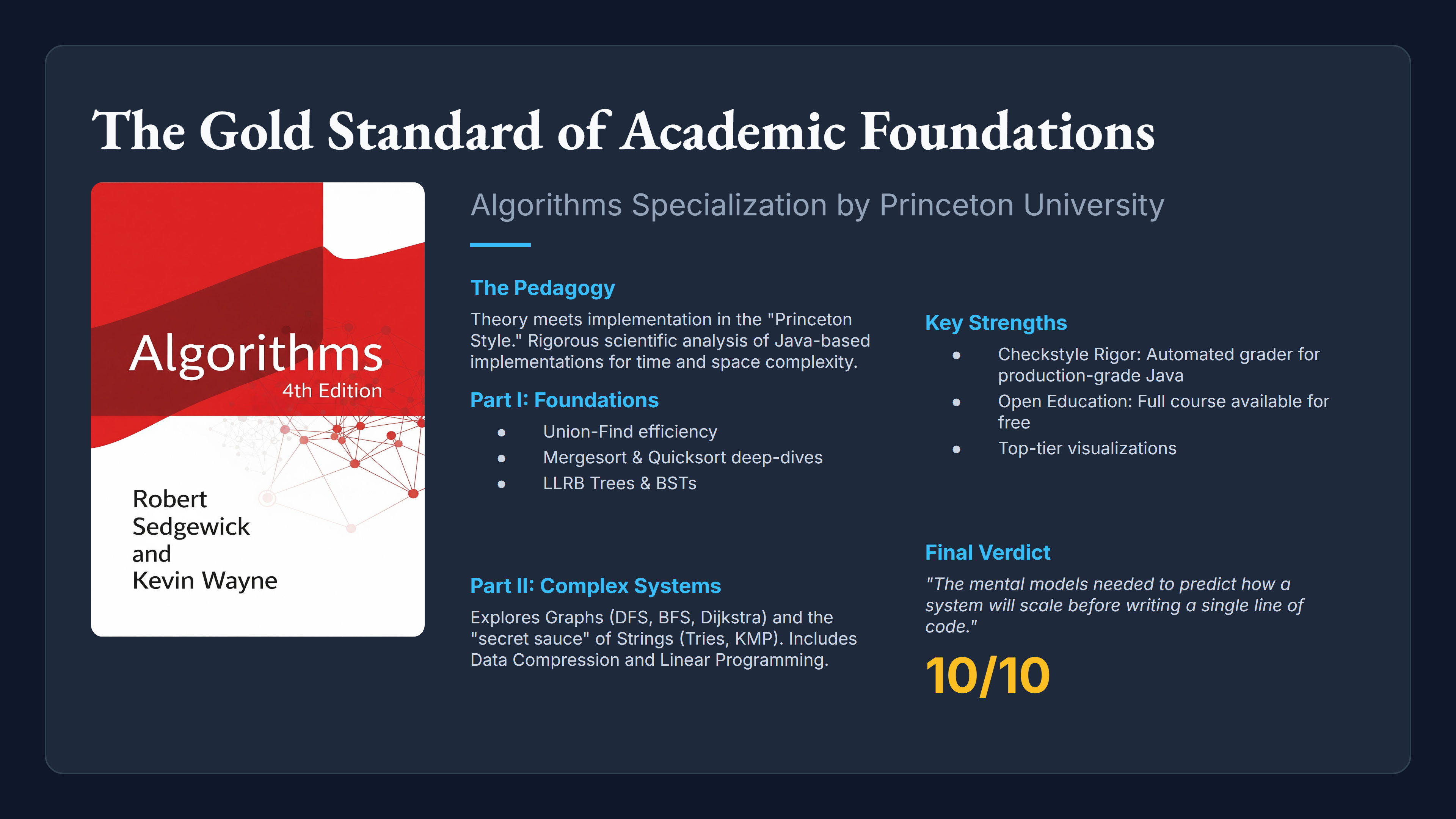
If you feel like your foundational knowledge has some holes, this is the remedy. Robert Sedgewick and Kevin Wayne offer what is widely considered the most brilliant, accessible, and entertaining explanation of data structures and algorithms ever filmed.
Why it matters: Unlike "LeetCode" grinding, this course focuses on the scientific analysis of algorithms. It teaches you how to mathematically predict if your system will scale before you even write the first line of code.
A Final Thought
The transition from a "coder" to an "engineer" is marked by a shift in focus: from the immediate dopamine hit of a passing test to the long-term stewardship of a system. As you look at your current project, ask yourself: If I left tomorrow, would this system thrive, or is its survival tied entirely to my presence in the room?
Have a question or suggestion?
There is more than one way to start a conversation:
- Create a post in our Reddit community.
- Fill out the form.
- Send us an email: info@relbis.com